HTMLGameSite editor's notebook
Pawgrid: Cat Logic Puzzle Guide
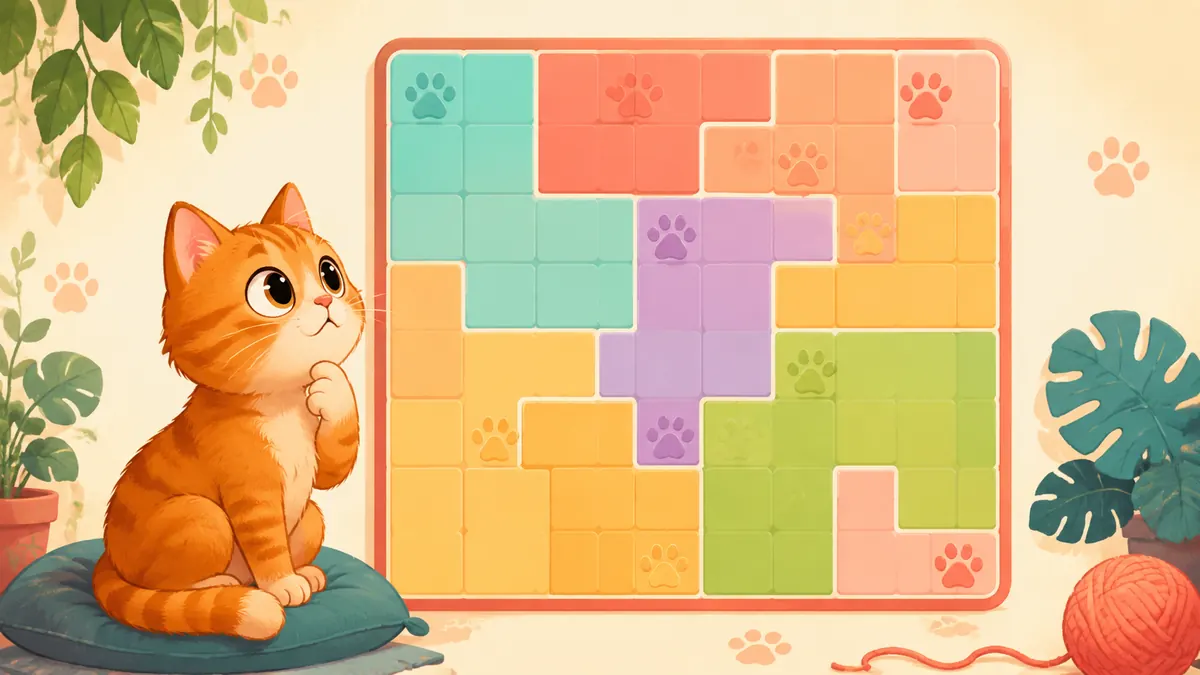
Pawgrid is an original deduction game about arranging cats inside an irregular grid of colored rooms.
Play Pawgrid: Cat Logic PuzzleWhat you are doing
Pawgrid is an original deduction game about arranging cats inside an irregular grid of colored rooms. A solved board contains exactly one cat in every horizontal row, one in every vertical column, and one in every colored region. Cats in neighboring rows may not touch at diagonal corners. Those four constraints overlap, so a fixed starter cat can eliminate its entire row and column, several diagonal cells, and part of its region before the player makes a move. Empty cells may be marked with an X while possibilities are compared. Correct cat placements increase the score and build a combo multiplier; an incorrect cat attempt is converted to an X, spends one of three Focus points, and breaks the streak. Clearing all required cat positions advances the run, while losing all Focus ends it. Cozy, Clever, and Master modes use 6-by-6, 7-by-7, and 8-by-8 boards respectively, with three stable, uniquely solved boards in each mode.
Controls
On a phone, tablet, or mouse, a single tap toggles an empty cell between blank and an X note. Rapidly double-tap the same cell within a short 320-millisecond window only when you intend to place a cat; a later second tap simply removes the X instead of risking a wrong-cat penalty. A single tap on a movable cat removes it. Drag across several empty cells to add a run of X notes without repeatedly lifting a finger. Mouse input follows the same Pointer Events path. Keyboard players move the highlighted cell with the arrow keys, press Space or Enter to cycle its mark, press H for a hint, Z to undo, and R to restart the current board. The locked starter cat cannot be removed. X marks are optional notes, but cat placements are checked immediately against the board's verified solution. The Hint button reveals one correct cat at a score cost, Undo restores the previous board and scoring snapshot, and Restart returns to the beginning of the current board without erasing points earned before that level.
Practical notes
- Expand every confirmed cat before searching elsewhere. Its row, column, colored region, and diagonal neighbors all become unavailable. Marking those cells makes later single-candidate rows and regions visible and protects the combo from an avoidable guess.
- Compare the smallest colored regions with the sparsest rows and columns. If a region's remaining cells share one row, that region must use the row even before the exact column is known, so cells belonging to other regions in that row can be rejected.
- Treat adjacent rows as a pair. When one row has two candidates, test how each candidate removes diagonals from the next row. A candidate that leaves the neighboring row with no legal cell is impossible, which often reveals a forced placement without spending a hint.
Before you start
Pawgrid has no countdown, remote media, or hidden energy timer. The best score and selected difficulty are stored only in the current browser through namespaced localStorage keys, with storage errors handled so private browsing does not stop play. Hints intentionally lower the current score and clear the combo, while Undo restores the exact score, Focus, combo, and board snapshot from before the most recent action. Each difficulty contains three reproducible boards rather than a different random layout on every restart. The local play package is noindex and carries no HTMLGameSite display-ad script; the canonical guide remains the public information page.
High-score strategy
- Protect high multipliers by using X marks as working notes and placing a cat only when row, column, region, and diagonal evidence agree. A correct sequence increases the combo, whereas a wrong cat costs Focus and returns the multiplier to its starting value.
- Before using a hint, rescan in a fixed order: smallest region, sparsest row, sparsest column, then adjacent-row conflicts. This routine reduces visual jumping and often uncovers the one elimination that was missed during free-form scanning.
- Use Undo to examine a short consequence chain instead of clearing the board. The snapshot includes notes and scoring state, so an explored branch can be reversed cleanly without destroying deductions that were already confirmed.
- Carry score between boards by restarting only the current level when its notes become confusing. The level-start score is preserved, making a controlled reset safer than piling uncertain marks onto a cluttered Master board.
Developer log
The runtime uses a 720-by-960 logical Canvas for a consistent three-to-four portrait composition. CSS scales the surface to the available column width, while JavaScript sizes the backing store for the device pixel ratio and keeps world coordinates unchanged. Pointer positions are converted through getBoundingClientRect before cell lookup, so mouse clicks, taps, and drags share one tested coordinate path. The pointer state machine records the last tapped cell and accepts a cat attempt only when the same cell is tapped again within 320 milliseconds; slower taps safely toggle the X note. Keyboard selection is drawn on the same Canvas and remains available even when touch controls are present.
Every level stores a region matrix, a verified solution permutation, and one locked starter cell. The accompanying generator grows connected regions from seeded cells, while a backtracking solver enforces one cat per row, column, and region plus the no-diagonal-touch rule. A board is accepted only when the solver finds exactly one solution. Keeping the generator with the source makes the nine released boards reproducible and prevents hand-edited region maps from silently introducing multiple answers.
READY, RUNNING, LEVEL_COMPLETE, and GAME_OVER states control input and progression. One requestAnimationFrame loop draws regions, cats, X notes, selection pulses, floating score labels, and a bounded particle pool. Animation uses a clamped elapsed-time value so a suspended browser tab cannot create a large update jump when restored. Undo copies only the small board and scoring state, DOM writes are limited to changed HUD text, and the local high-score access is wrapped in error handling. The authored HTML, CSS, JavaScript, and WebP cover stay well below one megabyte and gameplay needs no framework, font, audio file, image request, or network connection.
First-party package check
This original game is stored as a self-contained local package. Its authored runtime files were checked for launch, controls, state transitions, persistence, and responsive layout before publication.
- Validated
- 2026-08-22
- Files
- 4
- Package size
- 0.1 MiB
- Entry
- /local-games/pawgrid-cat-logic-r3/play.html
Why we kept it
Pawgrid is the shelf's first original first-party game rather than a captured provider package. It adds a calm, replayable portrait puzzle with verified unique boards, meaningful keyboard and touch support, visible combo feedback, and technical details that can be checked directly against the shipped source.
More from the edited shelf